Make ad creatives the priority
Most founders obsess over audiences and budgets and reuse one tired video. Reverse it. Broad targeting with ten fresh creatives beats surgical targeting with one, every time. Your creative pipeline is the automation.
Keep videos between 7 and 25 seconds
That is the window where completion rates and conversions meet. For some placements, cap at 15. Front-load the hook in the first two seconds: the scroll decision happens before your logo appears.
The $100 rule
Give every ad exactly $100 of spend to prove itself. At $100: turn it off, or move it into the winners ad set and scale. No feelings, no one more day. The rule exists so you make the call on data instead of hope.
Structure the account: testers and winners
Run two ad sets. A testers set at $20 a day where every new creative gets its shot, and a winners set at $100 a day where proven ads scale. The mechanics:
- 1Aim for 50 conversions a week to get out of the learning phase. If your cost per result is $10, multiply by 7.14: that's the daily spend you need.
- 2Promote a tester to the winners set once it has been profitable for about a week.
- 3Retire a winner when it fatigues for more than 5 to 7 days.
- 4Scale budgets 20 to 30% every 2 to 3 days, never in big jumps: big jumps reset learning.
Creative fatigue is a schedule, not a surprise
Every winning ad decays as the audience sees it again. Watch frequency and CPA, and have next week's creatives ready before this week's stop working. UGC-style ads fatigue slower than polished brand spots because they read as content, not advertising. Two marketplaces for sourcing UGC ad creatives:
Sponsor the indie watering holes
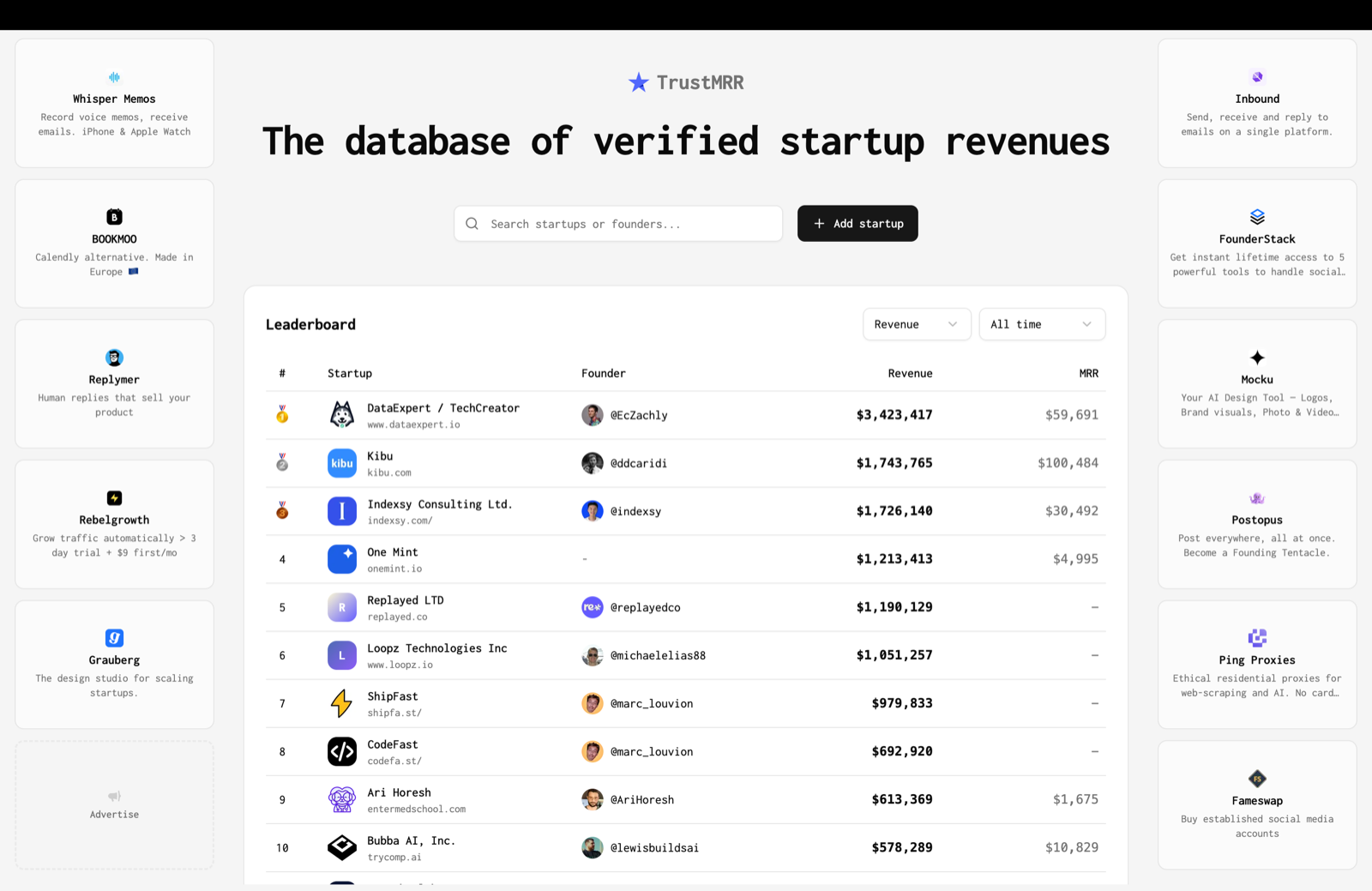
Not all paid distribution is an ads manager. Startup directories, leaderboards and niche newsletters sell fixed-price sponsor slots for a fraction of what the same eyeballs cost on Meta, and the audience is founders and early adopters actively browsing for tools. TrustMRR alone runs a dozen sidebar slots next to its revenue leaderboard. Buy a month on two or three sites where your buyer already scrolls, keep the copy to one plain sentence about what the product does, and treat it like any other ad: track clicks, keep the slots that pay for themselves.
Key moves
0/7Reading is warm-up. Check these off as you actually ship them; progress saves in your browser.
Feed the ads machine automatically
Winning ad accounts eat dozens of creatives a month. Viraloop generates UGC-style and faceless video variants from one brief, so your creative pipeline never runs dry.